
Ask “how many kilowatts do I need?” and the honest answer is that there is no single magic number, and anyone who rattles one off without looking at your actual room is guessing. Capacity is the one spec that quietly makes or breaks how an aircon performs, so it is worth getting right rather than rounding up and hoping. Here is what the sizing really hinges on, and how you land on the correct number for your place.
Bigger is not better with aircon
With plenty of appliances you can just buy the biggest one you can afford and call it a day. Aircon does not play by that rule. An oversized unit cools the room so quickly that it hits the setpoint and shuts off before it has had time to pull the humidity out of the air. Then it clicks straight back on a few minutes later, over and over. That stop-start behaviour, short-cycling, leaves the room feeling cold and clammy, wears the compressor out sooner, and chews through more power than a right-sized unit doing one steady job. So no, you do not want spare grunt just for the sake of it.
What actually decides the capacity
Floor area is only the starting point. Two rooms with the same square metreage can want very different units depending on what is going on around them. The things that push the number up or down:
- Room size and ceiling height: a bigger volume of air takes more grunt to shift, and high or raked ceilings hold far more air than a standard height room.
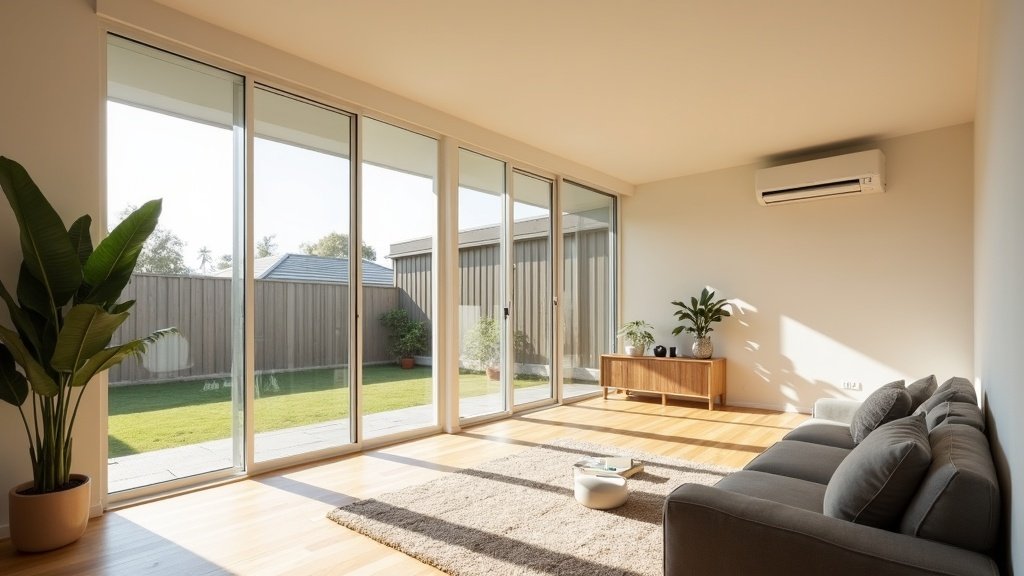
- Glazing: big windows, especially west-facing ones that cop the full afternoon sun, dump a heap of heat into a room and push the capacity up hard.
- Aspect and shading: which way the room faces, and whether eaves, trees or a neighbour’s wall keep the sun off it, changes the load right through the day.
- Insulation: a well-insulated ceiling and walls hold the conditioned air in, while an old uninsulated place leaks it and the unit has to keep replacing what it lost.
- Climate zone: a lounge room in Cairns has a very different cooling job to the same room in Hobart, and the local design conditions feed straight into the sizing.
Add in the little stuff too, like how many people are usually in there and whether the kitchen or a wall of electronics is throwing off heat. It all stacks up.
Rules of thumb versus a proper heat-load calculation
You will find plenty of quick guides online that hand you a figure off floor area alone. They are handy for a rough sanity check, a way to know whether you are shopping for a small bedroom unit or a big living-area one, and that is genuinely all they are good for. They cannot see your windows, your insulation or which way your lounge faces, so they will happily point you at the wrong size in a room that runs hot or cold for any of the reasons above.
A proper heat-load calculation runs all of those factors together and lands on a real number for your home instead of an average one. That is the job a qualified installer does before quoting. A specialist like Beyond Heating and Cooling will run the heat-load numbers on your actual house rather than eyeballing it, which is the difference between a system that quietly holds temperature and one that struggles or short-cycles. If you are spending real money on a new system, that is the step worth insisting on.
What the wrong size feels like day to day
Undersized is the obvious one. The unit runs flat out, never quite catches up on the hottest afternoons, and your bill climbs because it never gets to ease back. Oversized is the sneaky one, because people assume more capacity has to be safer. In practice it short-cycles, so the room swings between too cold and never-quite-dehumidified, the air feels damp rather than fresh, and the compressor cops all that stopping and starting. Neither one is comfortable, and both end up costing you more than the unit that was matched to the room in the first place.
When to hand the numbers to a pro
For a plug-in portable in a small room you can get away with a rough guide and move on. But for any fixed split or ducted system, where you are paying for the unit and a proper install, get the heat-load calculation done first. A split or ducted system has to be installed and connected by a licensed electrician for the electrical side and an ARC-licensed technician for the refrigerant work anyway, so a professional is already in the picture. Getting them to size it correctly at the same time just makes sense.
If you want to step back and see how sizing sits alongside choosing a type, running costs and keeping the thing healthy, our Australian home air conditioning guide ties the whole picture together. But the short version on sizing is this: match the unit to the room, not to your nerves, and let a real heat-load calc settle the number.