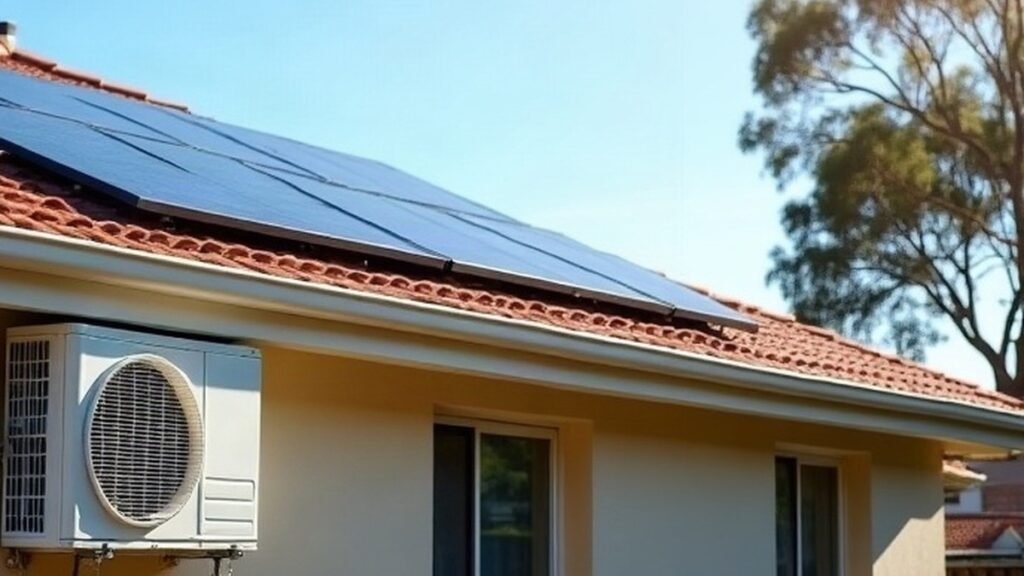

Yes, rooftop solar can carry a big share of your air conditioning, but only if you run the aircon when the panels are producing. If you get home at 6pm and flick the system on, you pull the whole load from the grid as the sun goes down. Shift the cooling into the middle of the day and the same panels do a lot more of the work.
Why timing matters so much
Your panels peak around midday and fade through the afternoon. The house runs the other way: it soaks up heat all day and is at its worst in the late afternoon and evening, when solar output is already falling.
That mismatch is the whole story. A big solar system that exports most of its midday power and then buys it back at night for the aircon isn’t saving you what it could. Whatever you export earns a feed-in tariff. Whatever you buy back in the evening costs you the retail rate. Check your bill and you’ll usually find the export rate is well below the import rate.
So the question isn’t “is my system big enough to run the aircon?” It’s “is my aircon running while the system is producing?”
Pre-cooling: use the house as the battery
Pre-cooling means running the aircon in the middle of the day, while the sun is up, so the house is already cool by the time everyone gets home. The government’s Your Home guide says that in a well-sealed, well-insulated house, pre-cooling may save on energy and energy costs. Cooling can be set to run when your rooftop solar has excess power, so the house is comfortable when everyone gets home and you avoid running the system in the evening peak (Your Home, Heating and cooling).
CSIRO and UNSW researchers modelled solar pre-cooling using hourly data from 349 Australian solar homes over the 2018 to 2019 summer. They found 97% of those homes had a demand pattern that pre-cooling could improve. The limit was the size of the aircon and the amount of spare solar, not anyone’s comfort (pv magazine Australia, reporting the CSIRO and UNSW study).
The point is to bank the cool while your own panels are supplying the power, so you need less from the grid for the aircon in the evening.
Setting it up in practice
- Start it early: set the system to come on late morning on hot days, while the panels are well into their output, rather than waiting for the house to heat up.
- Pick a sane temperature: Your Home recommends 25 to 27 °C in summer and says each extra degree of cooling adds about 5 to 10 per cent to the system’s energy use (Your Home).
- Close up the house: blinds down on the sunny side and doors shut on rooms you aren’t cooling.
- Back off in the evening: once the sun’s gone, let the system idle at a higher set point or switch to fan, and lean on what’s stored in the house.
If your system has Wi-Fi control, this gets easier. We’ve covered the options in our guide to smart thermostats and app control for aircon.
Where batteries come in
A home battery stores solar for when the panels aren’t producing, such as at night or on cloudy days, or for times when grid power costs more (energy.gov.au, Solar PV and batteries). For aircon, that means stored solar can cover some of the cooling after sunset instead of grid power.
The Australian Government’s Cheaper Home Batteries Program has been funding a discount of around 30% on eligible small-scale batteries connected to new or existing rooftop solar from 1 July 2025 (energy.gov.au). It doesn’t change the order of operations. Pre-cool first, because the house is storage you already own. Then ask whether a battery covers the evening load that’s left.
A battery also won’t fix an oversized or badly placed unit. If the system is short-cycling or fighting a hot room, see our guide to sizing a home air conditioner before you spend money storing power for it.
Tariffs: read your bill before you change anything
Your electricity plan decides how much all of this is worth. On a time-of-use plan, evening power is usually the dearest, so every kilowatt-hour you shift into the daytime saves the most. Your Home also notes that cooling can be timed to run when low or no-cost tariffs are on offer (Your Home).
Pull out your last bill and check three things: your feed-in tariff, your evening rate, and whether you’re on a flat or time-of-use plan. The gap between what you’re paid to export and what you pay to import is your saving on every unit of solar you use yourself. For a fuller look at the running side, see what air conditioning really costs to run in Australia.
Does it work for heating too?
Yes. A reverse-cycle system running at midday can warm the house while the sun is up and your panels are still producing, even if output is lower than in summer. The federal energy site makes the same point: the cost-effectiveness of heating is greatly improved when the power comes from solar panels (energy.gov.au, Heating and cooling). Our winter tips for reverse-cycle heating cover the settings side.
The short version for any solar home: run the aircon when the sun is doing the work, keep the set point sensible, and let a well-sealed house carry you into the evening.