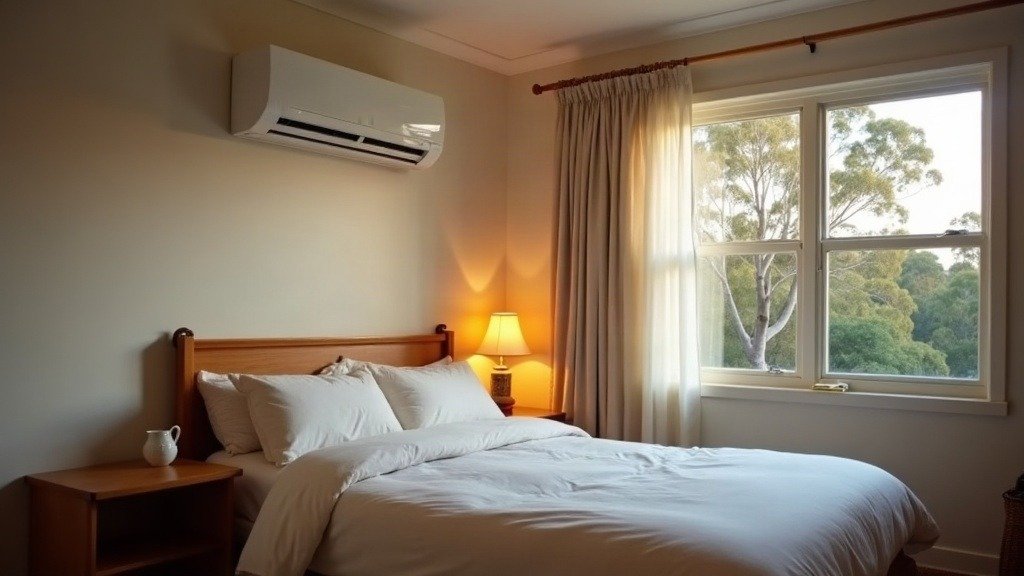

The short answer: a bedroom needs a gentler setup than the lounge. Point the air away from the bed, drop the fan to quiet, let sleep mode ease the set point up overnight, and judge a baby by feel rather than by the number on the remote. The setting that cools the living room at 4pm is usually too much for a sleeping room at 2am.
Why does the living room setting feel wrong at night?
During the day you’re moving around, the sun is on the walls and the room is full of people and appliances adding heat. At night most of that load is gone. The unit hits its target quickly, and if it’s still pushing air at high fan you get a cold, draughty room that cycles on and off.
A sleeping body also behaves differently. You’re still, you’re under a sheet, and a steady draught across your face or shoulders feels a lot colder than the thermostat suggests. So a couple of degrees warmer than your daytime setting, with less air movement, usually feels about right.
Where should the air actually go?
Not at the bed. This is the single biggest fix and it costs nothing. Set the vertical louvre so the airflow runs along the ceiling and turn off the auto swing. Cold air sinks, so it’ll still reach the room without landing on anyone.
For a cot, the same rule applies, just more strictly. Don’t put the cot under or directly in front of the indoor unit. If the room layout forces it, that’s worth fixing properly, and our guide to where to place a split system indoor unit covers what a good installer looks at before drilling the wall.
What do quiet mode and sleep mode really do?
They’re two different things.
- Quiet mode: runs the indoor fan at its lowest speed. Less noise, less draught, slightly slower to cool.
- Sleep or night mode: gradually shifts the set point while you sleep, so the unit works less as your body cools down overnight.
The exact behaviour of sleep mode varies by brand and model, so check your own manual. As one documented example, the AirTouch 5 controller’s Sleep/Away Mode raises the cooling set point by 1°C every hour for 3 hours, then holds that temperature until you cancel it. In heating it does the reverse, lowering the set point by 1°C an hour for 3 hours (AirTouch Help Centre). Other brands use different steps and limits, which is why the manual matters more than any rule of thumb.
In practice, sleep mode plus quiet fan is the combination I’d start with in almost any bedroom.
What temperature is safe for a baby’s room?
Here’s the part that surprises a lot of parents. Red Nose, the Australian safe sleep organisation, says there isn’t a specific room temperature recommended for safe sleep, because no evidence shows that a set temperature prevents sudden infant death (Red Nose, Safe Sleep overview).
Instead, their advice is to dress your baby for the room, the way you’d dress yourself: comfortably warm, not too hot or cold. Check by feeling your baby’s back or tummy, which should feel warm. Cool hands and feet are normal. Keep the head and face uncovered, because that’s how babies release heat.
So the aircon’s job in a nursery is simple. Keep the room steady and avoid big swings, then dress the baby to suit. If the room drifts colder in the early hours, that’s when sleep mode and a sensible starting set point earn their keep. Ask your child health nurse or GP about anything specific to your baby.
Is the air too dry, or too sticky?
Both can happen. In humid parts of Queensland and the Top End, a bedroom can feel clammy even when it’s not that hot. Dry mode pulls moisture out with less cooling, which can be more comfortable at night than dropping the temperature further.
In drier southern summers, the opposite problem shows up: people wake with a dry throat after running cooling all night. A higher set point and lower fan helps. So does a clean filter, because a dusty one makes the air feel stale. If the unit smells musty when it starts, have a look at our guide to why an air conditioner smells musty before running it in a nursery.
Should you use a timer or leave it running?
It depends on the night. On a mild evening, an off timer of two or three hours is fine. The room is cool when you drop off and warms slowly afterwards. On a 30 degree night in a western bedroom, switching off at midnight often means waking hot at 3am, and the unit then works hard to pull the room back down.
For those nights, sleep mode running through until morning usually beats a timer. If you’ve got a smart controller, a schedule that warms the set point slightly before dawn works well too. Our smart thermostat and aircon control guide walks through the options.
A starting point for most bedrooms
- Louvre: fixed, aimed along the ceiling, never at the bed or cot.
- Fan: quiet or low.
- Mode: cool with sleep mode on, or dry mode on humid nights.
- Set point: a couple of degrees warmer than your daytime setting, then adjust by feel.
- Baby: dressed for the room, back or tummy checked, head and face uncovered.
Winter is the same idea in reverse. Heat gently, keep the airflow off the bed, and don’t overheat the room. Our reverse cycle heating tips cover the colder months.
And if a unit can’t hold a bedroom steady on quiet fan, it may simply be undersized for that room. That’s worth checking against a proper kW sizing guide before you blame the settings.