
If you are putting in a split or ducted system, the aircon is only half the job. The other half is the wiring behind it, and that is the half that surprises people when the quote lands. A fixed system does not plug into a power point. It is wired back to your switchboard, and if that board is old or already full, the electrical work can cost a decent share of the total.
A hard-wired aircon is not a plug-in appliance
Plug-in portable and window units run off a normal power point and that is the end of the story. A wall-mounted split, a multi-split or a ducted system is different: it is connected permanently to your electrical installation, usually with its own supply run from the switchboard out to the outdoor unit. That counts as electrical installation work, which changes who is legally allowed to touch it and what paperwork you should walk away with. If you are still weighing up system types, the trade-offs are in our comparison of split, portable and window units.
Why it gets a circuit of its own
Fixed systems normally run on a dedicated circuit rather than sharing the general power circuits with your kettle, your fridge and whatever is plugged in out in the shed. Two reasons. A compressor pulls a solid hit of current when it kicks in, and if it is sharing with half the kitchen you get nuisance tripping. And a long cable run feeding a decent motor load has to be sized properly, which is a lot cleaner when the circuit only does one job.
The cable size and protective device get worked out by the electrician from the manufacturer’s rated load for your unit and the Wiring Rules. There is no universal answer, which is why anyone quoting a cable size over the phone, before seeing the unit’s data plate, is guessing.
The isolator, and why it matters more than people think
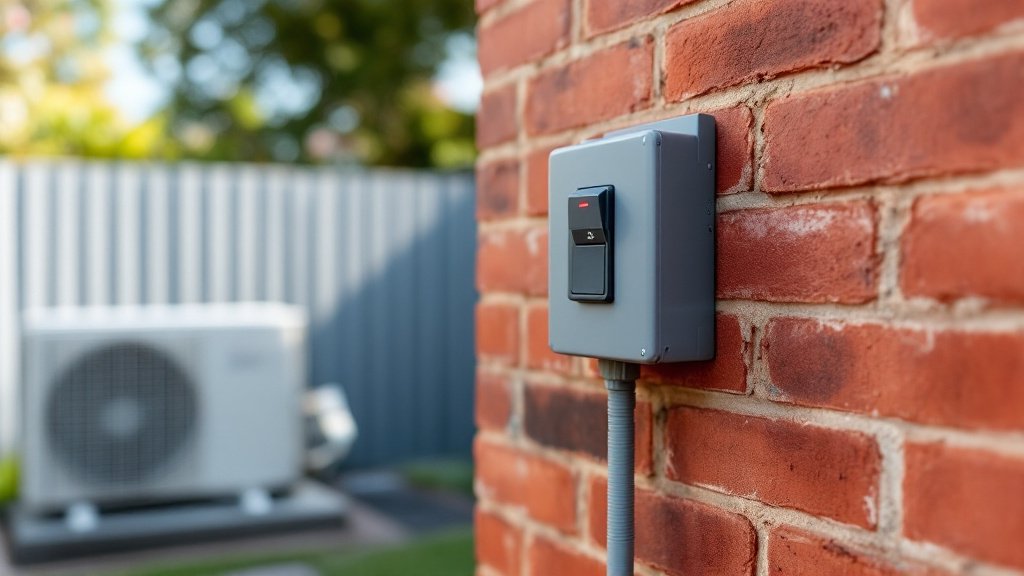
An isolating switch sits on the wall near the outdoor unit and lets someone cut power to the aircon on its own. It is not the circuit breaker in your switchboard, and it is not there for convenience.
It is there so a technician working on the outdoor unit can make the thing dead and prove it is dead while standing right next to it, rather than killing power to half the house from inside. If yours has not got one, or it has been buried behind a new deck or an overgrown hedge, expect a service tech to want that sorted before they start. Weatherproofing counts too, because that switch sits outside in the sun and rain for the life of the system.
When the switchboard is the real bottleneck
This is where aircon jobs quietly get delayed. A new circuit needs both room and capacity in your existing switchboard, and plenty of Australian homes are still running boards never designed for what a modern household puts through them. The usual blockers:
- No spare ways: the board is physically full, so there is nowhere to land a new breaker without rearranging or replacing it.
- Rewireable ceramic fuses: an older fuse board generally needs bringing up to modern breakers before new circuits get added.
- No safety switch protection: RCD requirements have tightened over the years, and new work can be the trigger for bringing protection up to current standards.
- Consumer mains and main switch capacity: the cable feeding your house has a limit, and a big ducted system stacked on top of an induction cooktop and an EV charger can push past it.
None of that is the installer being difficult. If the board cannot safely carry the load, it has to be fixed. Worth raising early, because a switchboard upgrade is a separate cost and usually a separate visit.
Who is legally allowed to do this work
Electrical work is licensed everywhere in Australia and the rules sit with your state regulator. In New South Wales, NSW Fair Trading states you must hold an electrical licence before undertaking any electrical wiring work, regardless of the cost or type of work. In Victoria, Energy Safe Victoria requires you to engage a registered electrical contractor for electrical installation work, and says a licensed electrician must provide a Certificate of Electrical Safety whenever that work is completed. NSW has its own equivalent, the Certificate of Compliance for Electrical Work. Whatever your state calls it, ask for the certificate and file it. That is your evidence the job was signed off properly.
There is a second licence in play too. Handling refrigerant falls under the national ARCtick scheme, administered by the Australian Refrigeration Council on behalf of the Australian Government, so whoever connects and charges the refrigeration side needs a refrigerant handling licence. Some outfits hold both tickets in house, others send an electrician and a refrigeration tech. Either is fine. Two unlicensed mates and a YouTube video is not.
Getting it sorted before the unit turns up
The smoothest installs are the ones where these questions got answered before the equipment was ordered. At quoting stage, ask your installer:
- Circuit: is this going on a dedicated circuit, and is that in the price or extra?
- Switchboard: has someone actually opened the board and confirmed there is room and capacity?
- Isolator: where is it going, and is it rated for outdoor use?
- Licences: who is doing the electrical work, and who holds the refrigerant handling licence?
- Certificate: which compliance certificate will I be given at the end?
Get straight answers on those five and the electrical side stops being the part that blows the budget out. Get vague answers and you have learned something useful about the quote. If your existing system keeps tripping its breaker, we walk through that in our guide to an aircon that runs but will not cool. For the bigger picture, start with our Australian home air conditioning guide.