
You can pull real heat out of a room without an air conditioner, but only in the right order: keep the sun off the glass first, move air across your skin second, and open the house up only when the outside air is genuinely cooler than the inside air. None of it holds a house at 24 degrees through a 40 degree afternoon, but it takes the sting out, and if you are renting or waiting on an installer, that is worth having.
Heads up: two of the product links below are Amazon affiliate links. We may earn a small commission if you buy through them, at no extra cost to you.
Start with the glass, because that is where the heat gets in
People reach for the fan first and the curtains last. That is backwards. The Australian Government’s YourHome guide puts it plainly: direct sun can generate the same heat as a single bar radiator over each square metre of surface, and effective shading can block up to 90% of that heat. Unprotected glass, it notes, is often the greatest source of heat entering a home.
Where the shading sits is what matters. An external awning, shutter, blind or even a bit of shadecloth on a tension wire stops the energy before it touches the glass. An internal blind only stops the light once the heat is already through the window. Internal is worth closing on the sunny side, but external is in a different league. In most Australian homes the window doing the damage is the west-facing one from about 3pm on, so if you only ever shade one properly, shade that one.
What a fan is actually doing
A fan does not make the air colder. It makes you colder. Moving air across your skin speeds up the evaporation of sweat and strips the warm layer sitting against you, so you feel several degrees cooler while the thermometer has not budged. Two things follow: point fans at people rather than at the room, and switch one off when you leave.
There is a limit to the trick. Victoria’s Better Health Channel advises that electric fans can help cool the body when the indoor temperature is below 39 to 40 degrees. Past that you are blowing air hotter than your skin over yourself, which stops helping. On a genuinely extreme day it is a cool shower, a wet towel, water, and a cooler building if you can get to one.
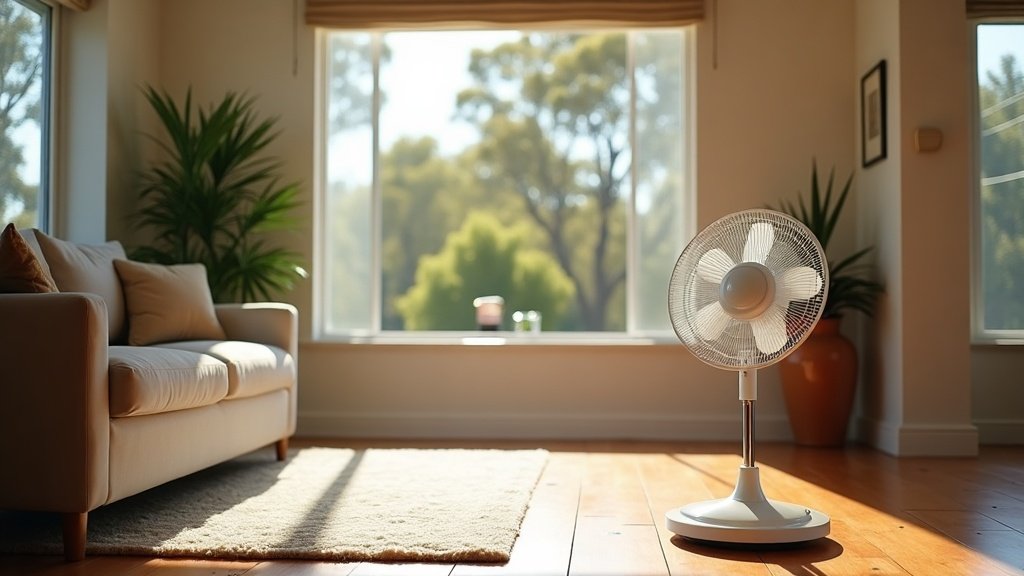
For a lounge or bedroom, an oscillating pedestal fan like this Kogan DC model covers more of the room than a small desk unit, and a DC motor runs quieter on low, which matters if it runs while you sleep. A ceiling fan does the same job with less clutter.
Ventilation is about timing, not just opening windows
Cross-ventilation only works if the air has somewhere to go. One open window is a dead end. Two openings on opposite sides, ideally at different heights, give you a path, and a box fan blowing outward from a window on the hot side moves that air faster than a fan in the middle of the room.
Timing is what people get wrong. Better Health Channel’s advice is to open up if you think it is hotter indoors than outdoors, which is worth testing rather than assuming. In the southern states that means flushing the house overnight, then shutting windows and pulling blinds by mid morning to hold the cool you banked. In the far north, where the night barely drops and the humidity stays up, that purge buys you far less.
Humidity, and where a dehumidifier earns its keep
Sweating is how your body dumps heat, and it only works if the sweat evaporates. Air already loaded with moisture slows that right down, which is why 30 degrees in Brisbane in February flattens you and 30 degrees in Mildura does not.
Be clear on what a dehumidifier does, though. It dries the air, it does not cool it, and it nudges the temperature up slightly because the motor and the condensing process both release heat into the room. What you get is air your sweat can work in, which is a real comfort gain even when the thermostat reads the same.
That makes it a coastal and tropical tool, not a general one. In Darwin, Cairns, Brisbane or a muggy Sydney week, running a plug-in room dehumidifier in a closed-off bedroom for a few hours before bed makes it much easier to sleep in. In dry inland heat it does nothing useful.
The heat you are making indoors
- Cooking: the oven and cooktop are the biggest heaters most homes own. Barbecue outside, or cook late and eat it cold tomorrow.
- Lighting: old halogen downlights run genuinely hot, so swapping to LED cuts the heat and the bill together.
- Appliances: dryers, dishwashers on the drying cycle and gaming PCs all end up as heat in the room. Run them at night.
- Unused rooms: shut the doors, because a smaller volume of air responds faster to everything else you are doing.
When these tactics stop being enough
If you cannot install anything because you are renting or in an apartment, a portable or window unit is the realistic next step, and we have weighed those up in split versus portable versus window air conditioners. If you are heading toward a proper system, get the capacity right before you worry about the badge, because an undersized or oversized unit disappoints either way. A split or ducted system is not DIY: the refrigerant work needs a technician holding a refrigerant handling licence, and the dedicated circuit is for a licensed electrician.
The shading you do now keeps working once a system is in, too. A well-shaded house asks less of an air conditioner, which means a smaller unit and a lower bill. Our Australian home air conditioning guide covers the rest of it.